
You’re standing in a tire shop, scrolling on your phone, or crouched in your driveway staring at the sidewall of your tire. It’s covered in numbers and letters—P225/65R17, 91H, XL—and none of it seems to make sense. You just wanted to replace a tire, not crack a secret code.
I’ve been there. Most drivers have. Whether you’re buying tires online, comparing prices at Discount Tire, or checking if that used set on Facebook Marketplace will actually fit your car, knowing how to read tire size saves you money, time, and a lot of frustration. The good news? Once it clicks, it’s surprisingly simple.
In this guide, I’ll walk you through how to read tire size numbers step by step—just like I explain it to customers in the shop or friends in the driveway. No fluff. No engineering degree required.
Problem Explanation
Understanding how to read your tire size is important because tires are not one-size-fits-all. The wrong size can mess with your speedometer, hurt fuel economy, cause uneven wear, or even create safety issues on the highway.
Every tire size tells a story about width, height, wheel diameter, load capacity, and speed rating. If you don’t know what those numbers mean, it’s easy to buy the wrong tire—especially online. That’s why learning how to read tire sizes properly is one of the most useful skills any driver can have.
Common Causes
Most drivers struggle with reading tire sizes for a few common reasons:
- Tire size numbers look technical and intimidating
- Dealerships and tire shops rarely explain them clearly
- Online listings assume you already know your size
- Car manuals are vague or buried in glove boxes
- Different formats for car, motorcycle, and bike tire sizes
None of this is your fault. The system just isn’t explained well.
Symptoms / Warning Signs
If you don’t know how to read your tire size, you might notice:
- Confusion when shopping for tires online
- Ordering tires that don’t fit your wheels
- Tire shop telling you “those won’t work”
- Uneven tire wear after replacement
- Speedometer reading slightly off
These are all signs it’s time to understand what those numbers really mean.
How to Read Tire Size: Step-by-Step Fixes / Solutions
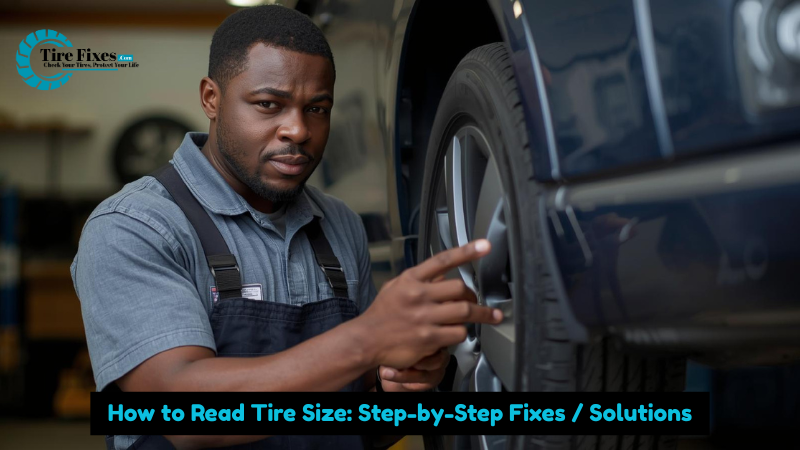
Step 1: Find the Tire Size on Your Tire
Look at the sidewall of your tire. You’ll see a sequence like:
P225/65R17 91H
This is your tire size. Let’s break it down piece by piece.
Step 2: Understand Tire Width (225)
The first number—225—is the tire width in millimeters.
- Measured from sidewall to sidewall
- Wider tires = more grip, less fuel economy
- Narrower tires = better efficiency, less road noise
This matters when fitting tires inside wheel wells.
Step 3: Read the Aspect Ratio (65)
The 65 is the aspect ratio. It’s the height of the tire’s sidewall as a percentage of its width.
- Higher number = taller sidewall, smoother ride
- Lower number = shorter sidewall, sportier handling
Example: 65 means the sidewall height is 65% of 225mm.
Step 4: Know What the “R” Means
The R stands for Radial construction.
- Almost all modern car tires are radial
- Better durability and heat dissipation
- You’ll rarely see anything else today
If there’s no “R,” that’s a red flag for modern vehicles.
Step 5: Read the Wheel Diameter (17)
The 17 means the tire fits a 17-inch wheel.
- Must match your wheel exactly
- A 17-inch tire will not fit a 16 or 18-inch rim
- This is non-negotiable
Always double-check this number.
Step 6: Load Index (91)
The 91 is the load index.
- It tells you how much weight each tire can carry
- 91 = 1,356 lbs per tire
- Your vehicle has a minimum required load rating
Never go below the manufacturer’s recommendation.
Step 7: Speed Rating (H)
The final letter—H—is the speed rating.
Common ratings include:
- S – up to 112 mph
- T – up to 118 mph
- H – up to 130 mph
- V – up to 149 mph
This doesn’t mean you should drive that fast—it reflects heat resistance and performance.
How to Read Motorcycle Tire Size
Motorcycle tire sizes often look like 180/55ZR17.
- 180 = width in mm
- 55 = aspect ratio
- ZR = high-speed radial
- 17 = wheel diameter
Same idea, slightly different format.
How to Read Bike Tire Size
Bike tires are usually simpler, like 26 x 2.1 or 700x25c.
- First number = wheel diameter
- Second number = tire width
Road bikes and mountain bikes use different standards, so always match exactly.
How to Read Tire Size: DIY vs Professional Repair
Reading tire size is absolutely a DIY skill. Anyone can do it with a flashlight and five minutes.
DIY Pros:
- Saves money
- Prevents wrong purchases
- Helps you compare prices confidently
Professional Help:
- Helpful if upsizing or downsizing tires
- Necessary for custom wheels
- Useful for performance setups
For everyday drivers, DIY knowledge is more than enough.
Safety Considerations
Using the wrong tire size can affect:
- Braking distance
- ABS and traction control
- Steering response
- Tire blowout risk
Always match the factory-recommended size unless you fully understand the impact.
Cost Expectations
Knowing how to read your tire size can save you $100–$300 per set by:
- Avoiding wrong orders
- Comparing online deals accurately
- Preventing premature tire wear
Knowledge pays for itself fast.
Prevention Tips
- Write your tire size in your phone
- Check driver’s door jamb sticker
- Match all four tires exactly
- Don’t trust “close enough” sizing
- Recheck size before ordering online
Common Mistakes
- Mixing wheel diameter sizes
- Ignoring load index
- Assuming wider is always better
- Buying tires based only on price
- Forgetting speed rating requirements
Conclusion / Final Advice
Once you know how to read tire size numbers, tire shopping stops being stressful. It becomes practical, predictable, and even empowering. Take five minutes, learn your size, and you’ll never feel lost in a tire aisle again. Your car—and your wallet—will thank you.
FAQs About How to Read Tire Size
1. How do I read my tire size correctly?
Look at the sidewall of your tire and read the full sequence. Each number and letter has a specific meaning related to width, height, and wheel fitment.
2. Can I change my tire size?
Yes, but only within safe limits. Changing size can affect speedometer accuracy, handling, and safety systems.
3. Are front and rear tire sizes always the same?
Most cars use the same size all around, but some performance vehicles use staggered setups.
4. How do I read tire size for my motorcycle?
Motorcycle tire sizes follow a similar pattern but may include speed ratings like ZR for high-performance use.
5. Where else can I find my tire size?
Check the driver’s door jamb sticker or your owner’s manual for factory-recommended sizes.

One Comment